

If you've been paying attention, you must have noticed that at the beginning of every lesson I've been asking you „Wie geht es dir?“ The subject is clearly ES (that's why it's GEHT and not GEHST). But what zum Teufel ist dieses DIR?
Well, if dich is the victim, then dir is the receiver. Think of it this way: I see you but I write to you. In the second case, I'm not scribbling on your face. I am writing a letter/an email to you. Kapierst du?
| nominativ | akkusativ | dativ | |
|---|---|---|---|
| 1 | ich | mich | mir |
| 2 | du | dich | dir |
| 3 | er / sie / es | ihn / sie / es | ihm / ihr / ihm |
| 1 | wir | uns | uns |
| 2 | ihr | euch | euch |
| 3 | sie / Sie | sie / Sie | ihnen / Ihnen |
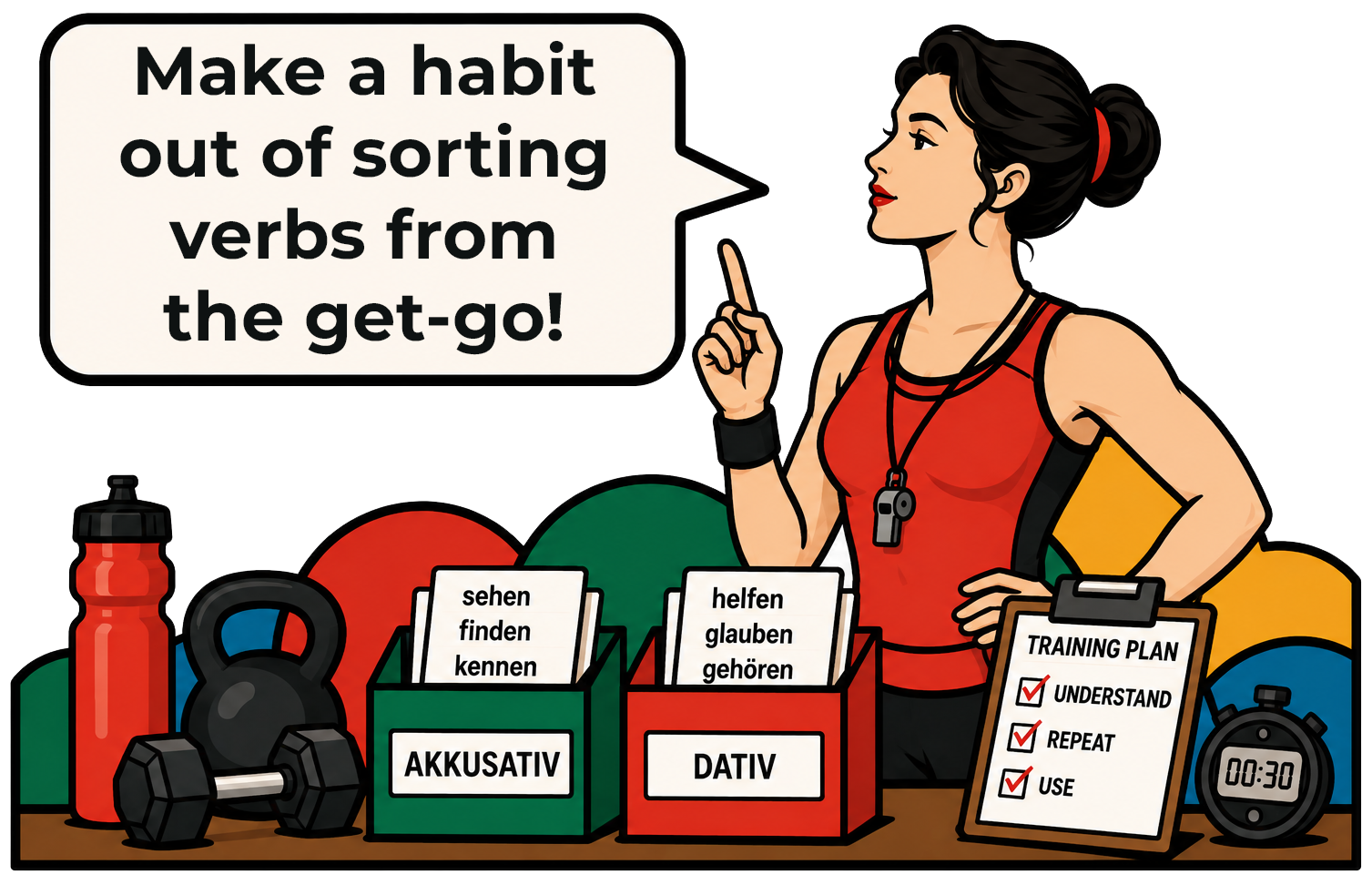
In German, some verbs take Akkusativ and some take Dativ.
At this point you can't think in English and speak in German anymore. Your best strategy is to learn Akkusativ and Dativ examples. Then USE THEM in REAL LIFE!
These verbs can only have a person as their indirect object - eg. you can help a friend, but not a table.
antworten · zuhören · begegnen · schaden · gratulieren · folgen
These verbs work the other way round (like the English verb "to belong"). We don't say "I belong to the book" but rather "The book belongs to me". You see, the book is the subject doing the belonging.
*gehen only works this way in „Wie geht es dir?" (lit. How goes it to you?)
Have you noticed? In English we use the verb "to like" for food and things we don't necessarily put in our mouths. In German there are two different verbs: „schmecken" and „gefallen".
Asking „Wie geht es dir?" is too easy. Would you know how to ask how other people are doing?
Here is a combined pronoun & article overview. Do you see how they move in unison?
| nominativ | akkusativ | dativ | |
|---|---|---|---|
| m | er (der Hund) | ihn (den Hund) | ihm (dem Hund) |
| f | sie (die Katze) | sie (die Katze) | ihr (der Katze) |
| n | es (das Auto) | es (das Auto) | ihm (dem Auto) |
| p | sie (die Freunde) | sie (die Freunde) | ihnen (den Freunden) |
Try to remember the bold path of the shifts. If you can explain this table and remember the position of the bold pronouns it's just a matter of time before they become intuitive.
Review the topics of this module while learning new vocabulary with the flashcard app.
Horizontally — third person pronouns and articles hold hands across the three cases:
| nominativ | akkusativ | dativ | |
|---|---|---|---|
| m | er (der Hund) | ihn (den Hund) | ihm (dem Hund) |
| f | sie (die Katze) | sie (die Katze) | ihr (der Katze) |
| n | es (das Auto) | es (das Auto) | ihm (dem Auto) |
| p | sie (die Freunde) | sie (die Freunde) | ihnen (den Freunden) |
Vertically — this becomes your second favorite table!
| definite | masculine | feminine | neuter | plural |
|---|---|---|---|---|
| Nominativ | der Hund | die Katze | das Auto | die Freunde |
| Akkusativ | den Hund | die Katze | das Auto | die Freunde |
| Dativ | dem Hund | der Katze | dem Auto | den Freunden |
wer → wen → wem
Wen siehst du?
Wem hilfst du?
jemand → jemanden → jemandem
Kennst du jemanden?
Hilfst du jemandem?
niemand → niemanden → niemandem
Kennst du niemanden?
Hilfst du niemandem?
- ER, EN, EM... - the same pattern again and again and again. You got this, Digger!
Wer / Wen / Wem
Jemand / Jemanden / Jemandem
Niemand / Niemanden / Niemandem
By now, it shouldn't be too hard to predict the following two tables:
| indefinite | masculine | feminine | neuter | plural |
|---|---|---|---|---|
| Nominativ | ein Hund | eine Katze | ein Auto | (-) Freunde |
| Akkusativ | einen Hund | eine Katze | ein Auto | (-) Freunde |
| Dativ | einem Hund | einer Katze | einem Auto | Freunden ! |
| negation | masculine | feminine | neuter | plural |
|---|---|---|---|---|
| Nominativ | kein Hund | keine Katze | kein Auto | keine Freunde |
| Akkusativ | keinen Hund | keine Katze | kein Auto | keine Freunde |
| Dativ | keinem Hund | keiner Katze | keinem Auto | keinen Freunden ! |
The idea is not that you learn all these tables by heart! The point is to use these visual representations to recognise and remember that the same patterns keep repeating across all of them.
While you're doing these exercises or practising with the flashcards scan for recurring mistakes! is too easy. In all likelihood you're getting 80% of the answers right EXCEPT for that stubborn bad habit you're struggling to debug.
As we saw in Lektion 4, certain prepositions are linked to Akkusativ. Can you remember all of them?
Wunderbar! Here's the list of the Dativpräpositionen:
Natürlich there is a Dativ song that can help you remember them.
Review the topics of this module while learning some useful vocabulary with the flashcard app.
Here are the Nominativ and Akkusativ tables you already know, for reference:
| Nominativ | masculine | feminine | neuter | plural |
|---|---|---|---|---|
| ich | mein | meine | mein | meine |
| du | dein | deine | dein | deine |
| er | sein | seine | sein | seine |
| sie | ihr | ihre | ihr | ihre |
| es | sein | seine | sein | seine |
| wir | unser | unsere | unser | unsere |
| ihr | euer | eure ! | euer | eure ! |
| Sie / sie | ihr / Ihr | ihre / Ihre | ihr / Ihr | ihre / Ihre |
| Akkusativ | masculine | feminine | neuter | plural |
|---|---|---|---|---|
| ich | meinen | meine | mein | meine |
| du | deinen | deine | dein | deine |
| er | seinen | seine | sein | seine |
| sie | ihren | ihre | ihr | ihre |
| es | seinen | seine | sein | seine |
| wir | unseren | unsere | unser | unsere |
| ihr | euren ! | eure | euer | eure ! |
| Sie / sie | ihren / Ihren | ihre / Ihre | ihr / Ihr | ihre / Ihre |
Have you noticed? Most native speakers write „Ich liebe meinen Bruder" but actually say: „Ich lieb' mein' Bruder"
| Dativ | masculine | feminine | neuter | plural |
|---|---|---|---|---|
| ich | ||||
| du | ||||
| er | ||||
| sie | ||||
| es | ||||
| wir | ||||
| ihr | ||||
| Sie / sie |
| masculine | feminine | neuter | plural | |
|---|---|---|---|---|
| ich | meinem | meiner | meinem | meinen -n |
| du | deinem | deiner | deinem | deinen -n |
| er | seinem | seiner | seinem | seinen -n |
| sie | ihrem | ihrer | ihrem | ihren -n |
| es | seinem | seiner | seinem | seinen -n |
| wir | unserem | unserer | unserem | unseren -n |
| ihr | eurem | eurer | eurem | euren -n |
| Sie / sie | ihrem / Ihrem | ihrer / Ihrer | ihrem / Ihrem | ihren / Ihren -n |
Feeling overwhelmed? Remember the 3-step process: understand, repeat, use. That's all you gotta do!
- Identify the owner
- Identify the gender of the person or thing owned
- Identify the role of the owned thing (subject, object, or receiver)
The 3-step process is useful when doing the exercises, but in real life conversations you won't have enough time to follow it. The best strategy is to identify the specific constructions you'll need when chatting and pack them ahead of the chat.
This is probably a good time to go back and review flashcards from the previous lessons with the flashcard app. What we're about to learn will require your maximum Konzentration!
So we've said that after certain prepositions (entlang · durch · um · gegen · für · bis · ohne) we always use Akkusativ, and after certain prepositions (aus · bei · mit · nach · seit · von · zu) we always use Dativ, right?
If that is true, how is it possible that some prepositions sometimes appear in Akkusativ and sometimes in Dativ?
| Präposition | Akkusativ (Richtung) | Dativ (Position) |
|---|---|---|
| an | Ich fahre an den See | Ich wohne am See |
| auf | Er stellt sie auf die Theke | Sie steht auf dem Tisch |
| hinter | Sie geht hinter das Haus | Sie ist hinter dem Haus |
| in | Wir gehen ins Kino | Wir sind im Kino |
| neben | Ich stelle es neben dich hin | Es steht neben dir |
| über | Hängst du die Lampe über den Tisch? | Die Lampe hängt über dem Tisch |
| unter | Der Hund geht immer unter den Tisch | Der Hund schläft unter dem Tisch |
| vor | Ihr könnt vor das Haus einparken | Das Auto steht vor dem Haus |
| zwischen | Ich lege mich zwischen ihn und sie | Ich liege zwischen ihm und ihr |
This song is inspired by Westerland (Die Ärzte). Fill in the blanks using der, die, das, ein, eine, kein, keinen, keinem, am, ins, zum, etc. — whatever makes sense to you.
Und ich les' kleines Buch
Es liegt hier auf Tischlein
Eines Tages les' ich durch
lange Pause
Wird nie Ende gehen
Wann werd' ich Hause gehen?
Manchmal öffne ich Augen
Beobachte ich Café
Niemand will heute helfen
Durst, sie wird so schwer
lange Pause
Wird nie Ende gehen
Wann werd' ich Hause gehen?
O, ich habe Arbeit
Ich verschwende all Geld
Warum bin ich nicht Hause?
Ich will zurück meiner Mama
Review the topics of this module while learning some useful vocabulary with the flashcard app.
In this lesson we learned about a third distinction German makes between direct and indirect objects. We saw that some verbs require the Akkusativ case and some require the Dativ case.
We divided the verbs that take Dativ into two groups:
- Personal verbs (helfen, danken, gratulieren, vertrauen, etc.)
- Schmecken-verbs (schmecken, gefallen, gehören, passen, etc.)
Additionally, we had a look at the prepositions that take Dativ:
We studied how Dativ affects pronouns (mir, dir, ihm, ihr, etc.), definite articles (dem, der, den), indefinite articles (einem, einer, -) and negation articles (keinem, keiner, keinem, keinen). Finally, we crafted the possessive article table for Dativ (meinem, meiner, meinen, etc.).
We worked with prepositions that sometimes take Akkusativ and sometimes Dativ:
The key to knowing which case to use:
Right away!
Post a sentence in German using a Dativ verb or a Dativ preposition. Make it personal — use a real person or situation in your life!
💬 „Wie geht es dir? Mir geht's super!"
💬 „Das Essen schmeckt meiner Mutter nicht."
Find a German sentence with a Wechselpräposition online or in a song. Post it and explain whether it takes Akkusativ or Dativ — and why.
Write two sentences: one using a Dativ verb (helfen, gefallen, etc.) and one using a Dativ preposition. Use real people or places.
Create a compact cheat sheet with all the Dativ verbs, Dativ prepositions, and the Wechselpräpositionen. Share a photo!
How many flashcard drills did you complete this week? Post your score and tell us which Dativ verb or construction you find hardest!
If you've been paying attention, you must have noticed that at the beginning of every lesson I've been asking you „Wie geht es dir?“ The subject is clearly ES (that's why it's GEHT and not GEHST). But what zum Teufel ist dieses DIR?
Well, if dich is the victim, then dir is the receiver. Think of it this way: I see you but I write to you. In the second case, I'm not scribbling on your face. I am writing a letter/an email to you. Kapierst du?
| nominativ | akkusativ | dativ | |
|---|---|---|---|
| 1 | ich | mich | mir |
| 2 | du | dich | dir |
| 3 | er / sie / es | ihn / sie / es | ihm / ihr / ihm |
| 1 | wir | uns | uns |
| 2 | ihr | euch | euch |
| 3 | sie / Sie | sie / Sie | ihnen / Ihnen |
In German, some verbs take Akkusativ and some take Dativ.
At this point you can't think in English and speak in German anymore. Your best strategy is to learn Akkusativ and Dativ examples. Then USE THEM in REAL LIFE!
These verbs can only have a person as their indirect object - eg. you can help a friend, but not a table.
antworten · zuhören · begegnen · schaden · gratulieren · folgen
These verbs work the other way round (like the English verb "to belong"). We don't say "I belong to the book" but rather "The book belongs to me". You see, the book is the subject doing the belonging.
*gehen only works this way in „Wie geht es dir?" (lit. How goes it to you?)
Have you noticed? In English we use the verb "to like" for food and things we don't necessarily put in our mouths. In German there are two different verbs: „schmecken" and „gefallen".
Asking „Wie geht es dir?" is too easy. Would you know how to ask how other people are doing?
Here is a combined pronoun & article overview. Do you see how they move in unison?
| nominativ | akkusativ | dativ | |
|---|---|---|---|
| m | er (der Hund) | ihn (den Hund) | ihm (dem Hund) |
| f | sie (die Katze) | sie (die Katze) | ihr (der Katze) |
| n | es (das Auto) | es (das Auto) | ihm (dem Auto) |
| p | sie (die Freunde) | sie (die Freunde) | ihnen (den Freunden) |
Try to remember the bold path of the shifts. If you can explain this table and remember the position of the bold pronouns it's just a matter of time before they become intuitive.
Review the topics of this module while learning new vocabulary with the flashcard app.
Horizontally — third person pronouns and articles hold hands across the three cases:
| nominativ | akkusativ | dativ | |
|---|---|---|---|
| m | er (der Hund) | ihn (den Hund) | ihm (dem Hund) |
| f | sie (die Katze) | sie (die Katze) | ihr (der Katze) |
| n | es (das Auto) | es (das Auto) | ihm (dem Auto) |
| p | sie (die Freunde) | sie (die Freunde) | ihnen (den Freunden) |
Vertically — this becomes your second favorite table!
| definite | masculine | feminine | neuter | plural |
|---|---|---|---|---|
| Nominativ | der Hund | die Katze | das Auto | die Freunde |
| Akkusativ | den Hund | die Katze | das Auto | die Freunde |
| Dativ | dem Hund | der Katze | dem Auto | den Freunden |
Wen siehst du?
Wem hilfst du?
Kennst du jemanden?
Hilfst du jemandem?
Kennst du niemanden?
Hilfst du niemandem?
- ER, EN, EM... - the same pattern again and again and again. You got this, Digger!
Wer / Wen / Wem
Jemand / Jemanden / Jemandem
Niemand / Niemanden / Niemandem
By now, it shouldn't be too hard to predict the following two tables:
| indefinite | masculine | feminine | neuter | plural |
|---|---|---|---|---|
| Nominativ | ein Hund | eine Katze | ein Auto | (-) Freunde |
| Akkusativ | einen Hund | eine Katze | ein Auto | (-) Freunde |
| Dativ | einem Hund | einer Katze | einem Auto | Freunden ! |
| negation | masculine | feminine | neuter | plural |
|---|---|---|---|---|
| Nominativ | kein Hund | keine Katze | kein Auto | keine Freunde |
| Akkusativ | keinen Hund | keine Katze | kein Auto | keine Freunde |
| Dativ | keinem Hund | keiner Katze | keinem Auto | keinen Freunden ! |
The idea is not that you learn all these tables by heart! The point is to use these visual representations to recognise and remember that the same patterns keep repeating across all of them.
While you're doing these exercises or practising with the flashcards scan for recurring mistakes! is too easy. In all likelihood you're getting 80% of the answers right EXCEPT for that stubborn bad habit you're struggling to debug.
As we saw in Lektion 4, certain prepositions are linked to Akkusativ. Can you remember all of them?
Wunderbar! Here's the list of the Dativpräpositionen:
Natürlich there is a Dativ song that can help you remember them.
Review the topics of this module while learning some useful vocabulary with the flashcard app.
Here are the Nominativ and Akkusativ tables you already know, for reference:
| Nominativ | masculine | feminine | neuter | plural |
|---|---|---|---|---|
| ich | mein | meine | mein | meine |
| du | dein | deine | dein | deine |
| er | sein | seine | sein | seine |
| sie | ihr | ihre | ihr | ihre |
| es | sein | seine | sein | seine |
| wir | unser | unsere | unser | unsere |
| ihr | euer | eure ! | euer | eure ! |
| Sie / sie | ihr / Ihr | ihre / Ihre | ihr / Ihr | ihre / Ihre |
| Akkusativ | masculine | feminine | neuter | plural |
|---|---|---|---|---|
| ich | meinen | meine | mein | meine |
| du | deinen | deine | dein | deine |
| er | seinen | seine | sein | seine |
| sie | ihren | ihre | ihr | ihre |
| es | seinen | seine | sein | seine |
| wir | unseren | unsere | unser | unsere |
| ihr | euren ! | eure | euer | eure ! |
| Sie / sie | ihren / Ihren | ihre / Ihre | ihr / Ihr | ihre / Ihre |
| Dativ | masculine | feminine | neuter | plural |
|---|---|---|---|---|
| ich | ||||
| du | ||||
| er | ||||
| sie | ||||
| es | ||||
| wir | ||||
| ihr | ||||
| Sie / sie |
Have you noticed? Most native speakers write „Ich liebe meinen Bruder" but actually say: „Ich lieb' mein' Bruder"
Feeling overwhelmed? Remember the 3-step process: understand, repeat, use. That's all you gotta do!
- Identify the owner
- Identify the gender of the person or thing owned
- Identify the role of the owned thing (subject, object, or receiver)
The 3-step process is useful when doing the exercises, but in real life conversations you won't have enough time to follow it. The best strategy is to identify the specific constructions you'll need when chatting and pack them ahead of the chat.
This is probably a good time to go back and review flashcards from the previous lessons with the flashcard app. What we're about to learn will require your maximum Konzentration!
So we've said that after certain prepositions (entlang · durch · um · gegen · für · bis · ohne) we always use Akkusativ, and after certain prepositions (aus · bei · mit · nach · seit · von · zu) we always use Dativ, right?
If that is true, how is it possible that some prepositions sometimes appear in Akkusativ and sometimes in Dativ?
| Präposition | Akkusativ (Richtung) | Dativ (Position) |
|---|---|---|
| an | Ich fahre an den See | Ich wohne am See |
| auf | Er stellt sie auf die Theke | Sie steht auf dem Tisch |
| hinter | Sie geht hinter das Haus | Sie ist hinter dem Haus |
| in | Wir gehen ins Kino | Wir sind im Kino |
| neben | Ich stelle es neben dich hin | Es steht neben dir |
| über | Hängst du die Lampe über den Tisch? | Die Lampe hängt über dem Tisch |
| unter | Der Hund geht immer unter den Tisch | Der Hund schläft unter dem Tisch |
| vor | Ihr könnt vor das Haus einparken | Das Auto steht vor dem Haus |
| zwischen | Ich lege mich zwischen ihn und sie | Ich liege zwischen ihm und ihr |
Und ich les' kleines Buch
Es liegt hier auf Tischlein
Eines Tages les' ich durch
lange Pause
Wird nie Ende gehen
Wann werd' ich Hause gehen?
Beobachte ich Café
Niemand will heute helfen
Durst, sie wird so schwer
lange Pause
Wird nie Ende gehen
Wann werd' ich Hause gehen?
In this lesson we learned about a third distinction German makes between direct and indirect objects. We saw that some verbs require the Akkusativ case and some require the Dativ case.
We divided the verbs that take Dativ into two groups:
- Personal verbs (helfen, danken, gratulieren, vertrauen, etc.)
- Schmecken-verbs (schmecken, gefallen, gehören, passen, etc.)
Additionally, we had a look at the prepositions that take Dativ:
We studied how Dativ affects pronouns (mir, dir, ihm, ihr, etc.), definite articles (dem, der, den), indefinite articles (einem, einer, -) and negation articles (keinem, keiner, keinem, keinen). Finally, we crafted the possessive article table for Dativ (meinem, meiner, meinen, etc.).
We worked with prepositions that sometimes take Akkusativ and sometimes Dativ:
The key to knowing which case to use:
Right away!
Find a German sentence with a Wechselpräposition online or in a song. Post it and explain whether it takes Akkusativ or Dativ — and why.
Write two sentences: one using a Dativ verb (helfen, gefallen, etc.) and one using a Dativ preposition. Use real people or places.
Create a compact cheat sheet with all the Dativ verbs, Dativ prepositions, and the Wechselpräpositionen. Share a photo!
How many flashcard drills did you complete this week? Post your score and tell us which Dativ verb or construction you find hardest!
